Visionary is a global innovator, ushering in a new era with innovative high-value business models and diversified development strategies.
Visionary is collaborating with Ontario College of Art and Design to combine science and creativity to develop business models in the fields of holography and 3D autostereoscopic simulation. CEDBank by Frank Chen 28 May 2024
Visionary Group is a company listed on NASDAQ in the United States (NASDAQ code: GV). It is the best strategic business model for the transformation of the world's top 1 diversified innovative high-value niche market, which will create considerable high-profit growth for the group's enterprises. It is known for its innovative high-value business model development with a global forward-looking professional vision.
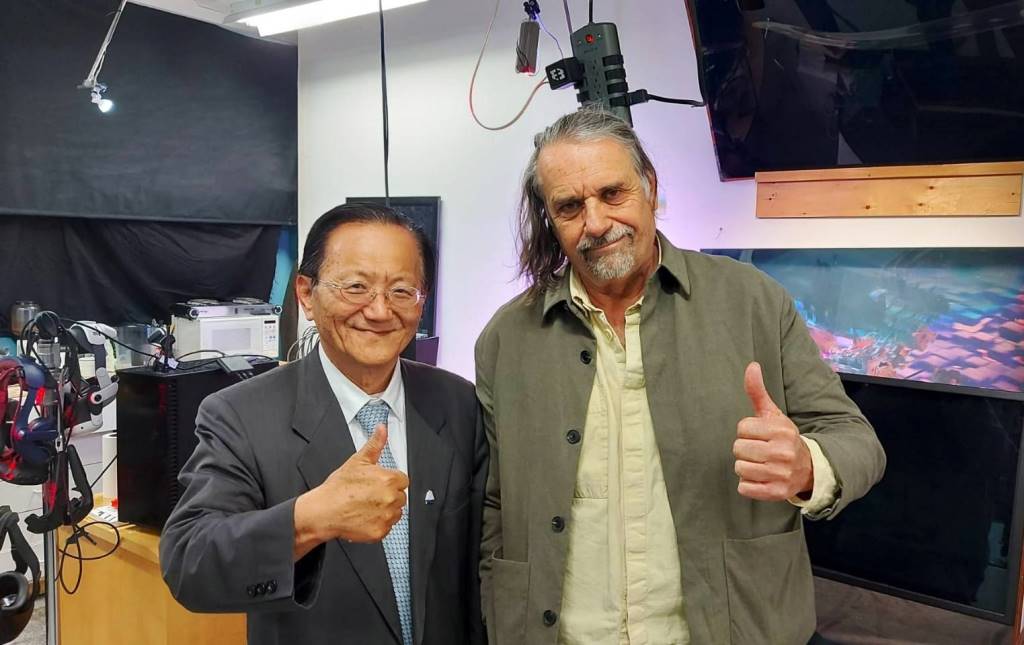
Dr. William Chai, Chairman of the Board of Directors of Global Vision Holdings (GV), and Professor Michael Page jointly deepened their cooperation and explored the value of business models in the fields of holography and 3D autostereoscopic simulation at the PHASE Lab
The collaboration between GV and OCAD combines science and creativity to develop new business models in the field of holography and 3D autostereoscopic simulation. GV and OCAD create the best value business model in the market in the field of holography and 3D autostereoscopic simulation.
1. Innovative products and services:
- **High-end holographic display devices**: Leveraging GV's technology development capabilities and OCAD's design innovations, launch market-leading holographic display devices for education, entertainment, advertising and medical fields.
- 3D stereo content production and distribution platform: Create an integrated platform that allows users to easily create, share and consume 3D stereo content, expanding to markets such as games, movies and virtual presentations.
2. Cross-industry solutions:
- Education and training: Provide advanced holographic and 3D simulation solutions to enhance the learning experience, such as virtual anatomy classes, historical event reenactments, etc.
- Medical field: Develop holographic and 3D stereo solutions for medical imaging and surgical planning to help doctors visualize complex surgical operations.
3. User experience and customer relations:
- Customized solutions: Tailor holographic and 3D stereo products and services to meet specific industry applications for different customer needs.
- User-friendly interface: Ensure that products and platforms are simple and intuitive to use, and improve customer satisfaction and loyalty.
4. Marketing and brand building:
- **Brand co-branding and cooperation**: Improve market awareness and brand reputation through cooperation with well-known brands, technology companies and art institutions.
- Global market expansion: Promote not only in the North American market, but also in the global market to gain a larger market share.
5. R&D and technological leadership:
- Continuous innovation: Invest in R&D, continuously iterate and innovate products, and maintain technological leadership.
- Patent protection: Patent protection for core technologies and innovative solutions to establish competitive barriers.
6. Ecosystem and community building:
- **Developer and designer community**: Build an active developer and designer community to encourage the creation and sharing of new holographic and 3D stereo content and applications.
- Education and support programs: Provide training and support programs to help customers and partners quickly master new technologies and products.
PHASE Lab (Prototyping Holographic Artistic and Scientific Exploration), under the leadership of Professor Michael Page, has become an important interdisciplinary research center that combines art and science, especially in the fields of holography and 3D autostereoscopic simulation. The lab is located at the Ontario College of Art and Design (OCAD) and continues to push the forefront of holographic technology. Here are some of the lab's milestones and achievements:
1. The origin and development of holography:
Professor Michael Page has been working on holography since the 1970s, inspired by the early innovative displays at the Ontario Science Center. He has collaborated with holographic artists and scientists around the world, including Lon Moore, Lloyd Cross, Dan Schweitzer and Sam Moree, to promote the development of holography.
2. The combination of technology and art:
In the 1990s, PHASE Lab did a lot of commercial work in holography and also received federal funding to develop several innovations. For example, the Visible Human Project in collaboration with Dr. Emmett Leith and the light valve digital holographic printer developed with Dr. Stephen Benton. These innovations not only promote technological progress, but also promote education and artistic creation.
3. Robotic artifact scanner:
In 2006, the laboratory developed the Huxley robotic artifact scanner, which enables museums to efficiently perform 3D scanning of artifacts.
4. RAIL holographic scanner:
In 2008, the laboratory cooperated with STM Holographic to develop the RAIL (Real World Acquisition and Image Link) holographic scanner, which can accurately record the real world and CGI scenes to form a seamless 3D composite image.
5. Education and curriculum development:
In order to promote holographic research, Professor Page designed and taught a holographic course at OCAD and opened a joint course at the University of Toronto, cultivating a large number of students interested in optics and holography.
6. Tactile hologram:
In 2012, the PHASE laboratory cooperated with Entact Robotics to study tactile holograms, allowing users to "touch" holograms and add interactive functions and synchronized audio. The development of this technology enhances the interactivity and application value of holograms.
7. 3D display of brain electrical activity:
In 2014, in collaboration with STM Holography and Cerebral Diagnostics, the laboratory developed a 3D view technology to capture and display brain electrical activity during sleep.
These achievements not only demonstrate the outstanding contributions of PHASE Lab in the fields of science and art, but also lay a solid foundation for the continuous evolution and wider application of holography.
Professor Michael Page's team at PHASE Lab focuses on using holographic technology to visualize and show the complex processes that the brain undergoes during sleep to the public and medical staff," Professor Page explained. This cutting-edge technology has great potential, especially in the fields of medical imaging and teaching.
Looking to the future of holographic research
PHASE Lab’s research and development continues to evolve, covering an amazing range of fields from medicine to entertainment to education. Researchers at the lab are exploring integration with augmented reality (AR) and virtual reality (VR) to further push the boundaries of immersive experiences. Professor Page noted that they are working with experts in the field of computer graphics to merge their holographic technology with the currently popular VR and AR technologies to create a more interactive and immersive experience.
Education and public engagement
PHASE Lab is not only focused on cutting-edge research, they are also committed to education and public engagement. “We think it is very important to introduce holography in higher education,” said Professor Page. “Through the collaboration between OCAD and the University of Toronto, we hope to cultivate the next generation of research talent in holographic technology and interdisciplinary fields.” These courses attract students from all over the world and provide them with a comprehensive education and practice platform.
Application and cooperation in industry
In addition to its achievements in academia, PHASE Lab has also established partnerships with multiple industry partners to develop holographic technology in practical applications such as industry, medicine, and museum displays. For example, their current collaboration with the automotive industry uses holographic technology to evaluate and optimize the design of new models. "Holographic technology not only provides a more intuitive way to evaluate designs, but also reduces the cost and time of manufacturing physical models," Professor Page explained.
A step towards the future
PHASE Lab's research results are not limited to static three-dimensional imaging. Its dynamic holograms and tactile technology are gradually transforming into more complex and interactive multi-sensory experiences. Professor Page and his team firmly believe that with the continuous advancement of technology, holograms will become one of the main media for display and expression in the future, with far-reaching and wide-ranging impacts.
Professor Michael Page and his PHASE Lab have achieved remarkable results and made great contributions in the field of holographic technology. Their research not only expands the application field of holograms, but also provides valuable practical experience and theoretical support on how to combine science and art. Through cooperation with academia, industry and public institutions, PHASE Lab continues to promote the development of holographic technology so that it can serve society more widely. Their work has undoubtedly laid a solid foundation for the future development of holographic technology.
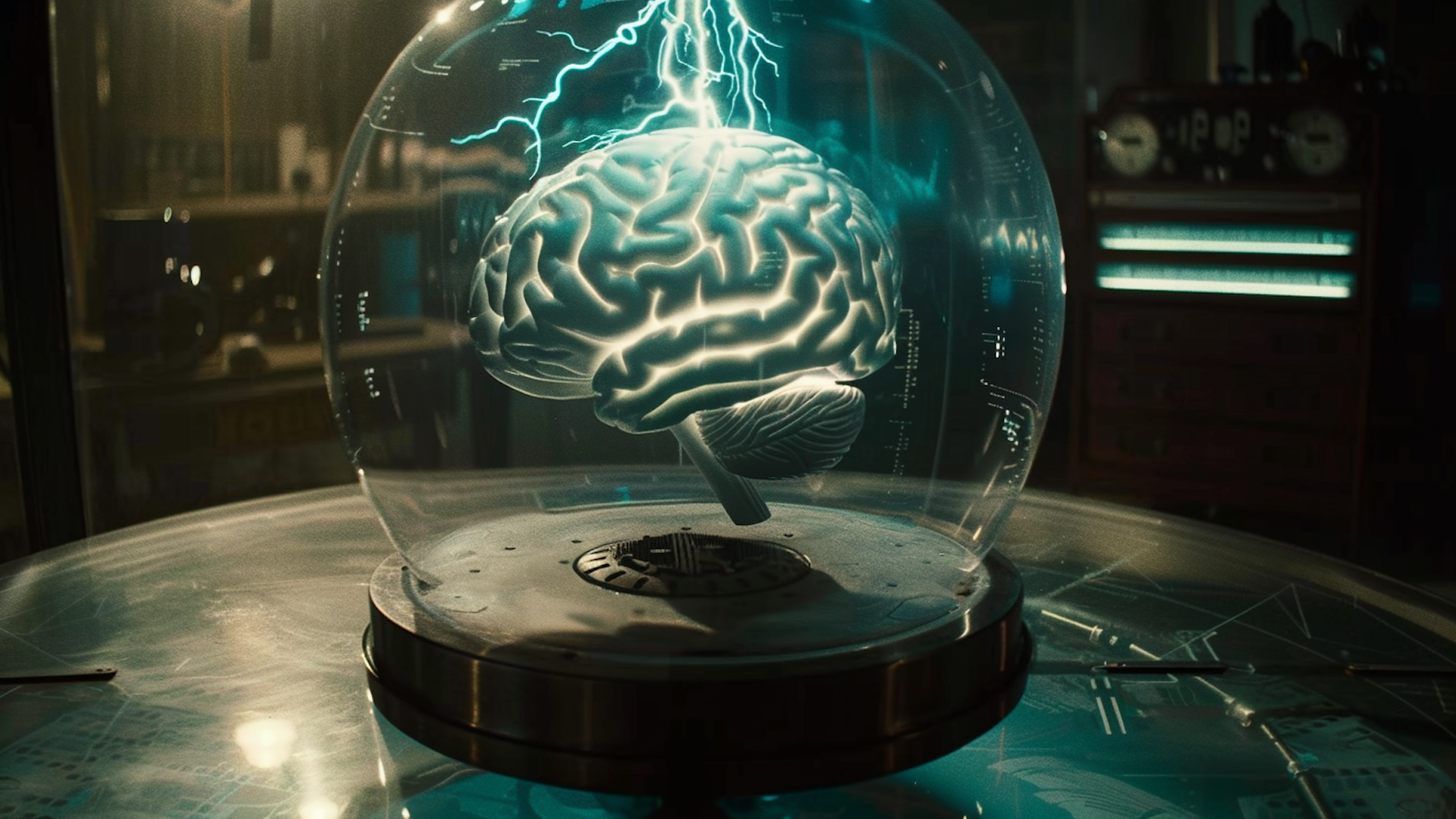
At the Ontario College of Art and Design, commonly known as OCAD, Professor Michael Page leads the PHASE Lab, a "Prototype Hologram for Art and Science Exploration." For the past decade, a team of researchers at the lab has been combining science and creativity to explore autostereoscopic 3D simulations using a variety of techniques, from digital holography to computational photography and haptics. By Debra Kaufman March 25, 2024
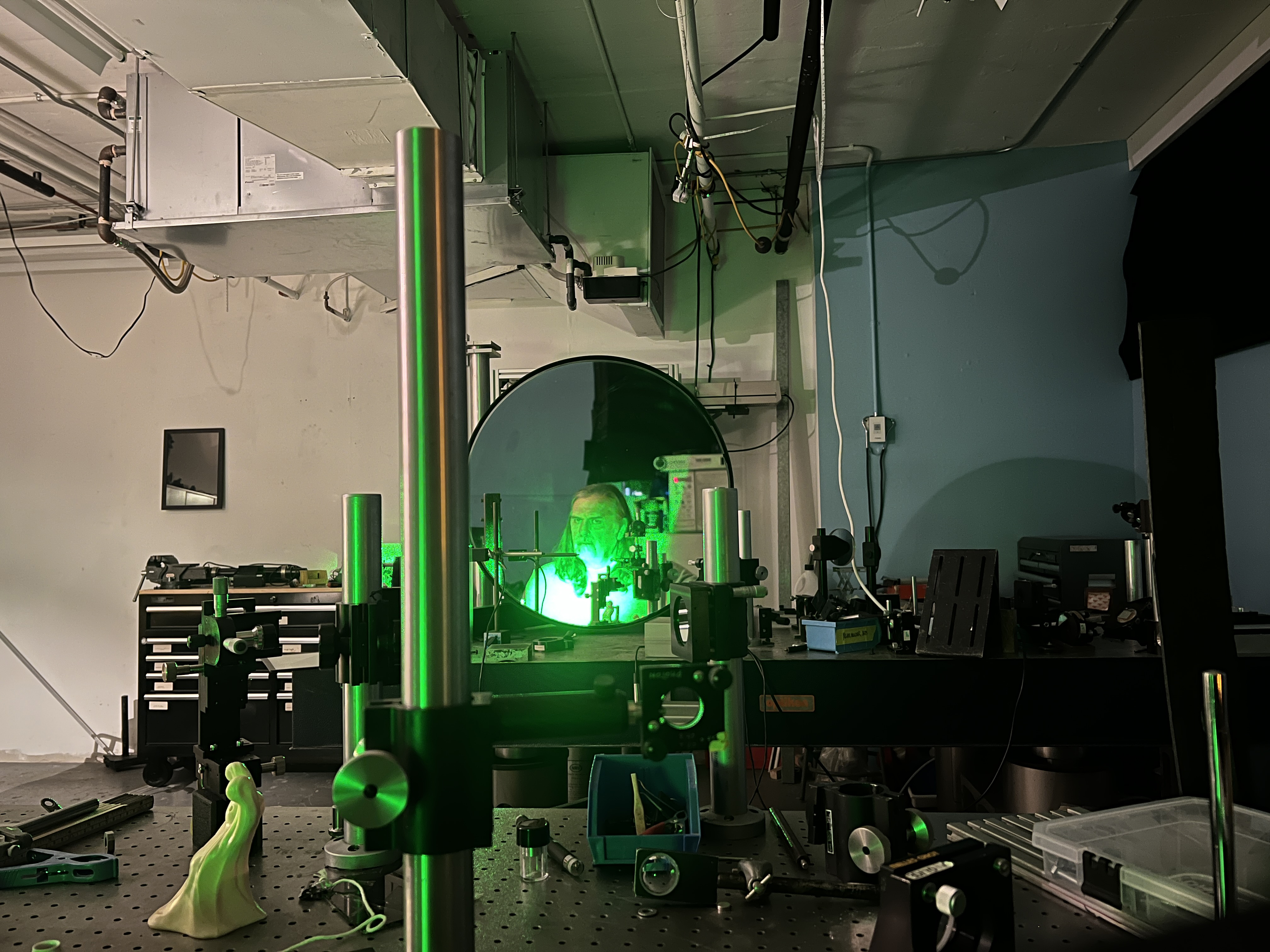
Professor Michael Page of the PHASE Lab | Image courtesy of the PHASE Lab
Page’s own path to holography can be traced back to his early interest in some innovative displays at the Ontario Science Centre, where he began focusing on holography in the 1970s. “Holography was in its infancy,” he said. “There were few places to study it other than MIT and the Art Institute of Chicago. We set up a simple holographic studio, first in the basement of a farmhouse, and then a second studio at OCAD.” He added, “We had great support for our research. I was able to travel and study with holographic artists around the world, such as creative holographic artist Lon Moore, physicist Lloyd Cross, Holographic Art Center co-director Dan Schweitzer, and holographic artist Sam Moree.”
At PHASE Lab in the 1990s, “We were doing some commercial work, and the group received some federal funding to advance the technology. We developed several innovations in the media space, working with graduate students, U of T scientists, and professionals in other fields. PHASE Lab worked with Dr. Emmett Leith, co-inventor of 3D holography, on the Visible Human Project; and with Dr. Stephen Benton of the MIT Media Lab, inventor of the rainbow hologram, to develop the light-valve digital holographic printer. “It was a novel full-color digital holographic printer, the first in Canada, and we used it to create holograms for art and science, as well as teaching tools for more than two decades,” Page said. “By the end of the program, our empirical knowledge of holography had transitioned to an understanding of optical physics, and the physicists on the project were beginning to create art.”
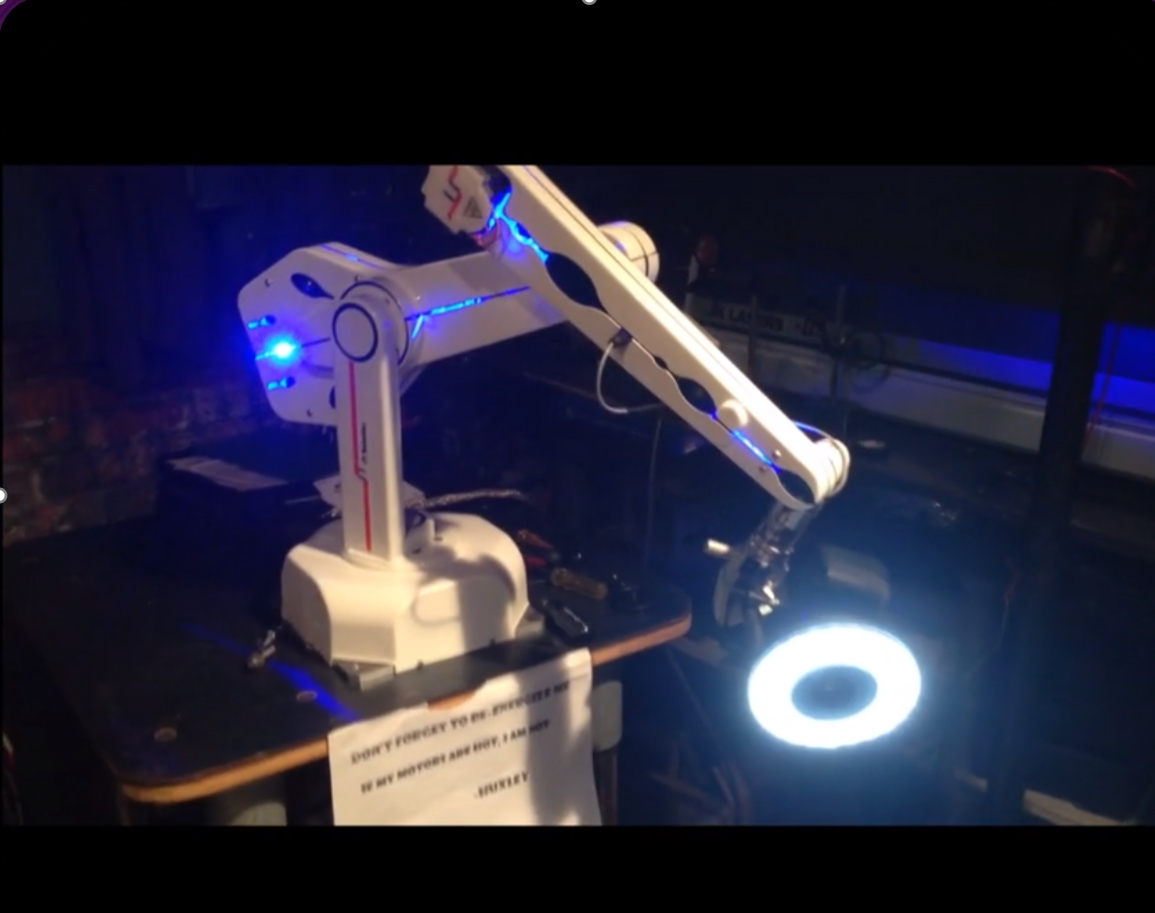
Huxley Robotic Artifact Scanner | Image courtesy of PHASE Labs
Over the years, PHASE Labs has focused on a number of projects with an eye toward medical and educational uses. In 2006, the lab built the Huxley Robotic Artifact Scanner, an early effort in the field of photogrammetry. “This was to allow museums to do high-quality 3D scans of their artifacts,” Page explains.
In 2008, the RAIL (Realistic Acquisition and Image Liaison) holographic scanner was introduced, created in conjunction with sponsor partner STM Holographic. “It uses a movie camera to record a 4D picture at the necessary angles and positions, which is then fed directly into a holographic printer,” Page recalls. “It works anywhere there’s studio lighting, and gives you metadata to facilitate 3D compositing of real-world images with computer-generated images.” The system is known for its ability to “record live subjects and live objects with absolute precision, and adjust on the fly to the printer’s specifications.” The “optically encoded motors are programmable” and perfectly match real-world and CGI scenes.
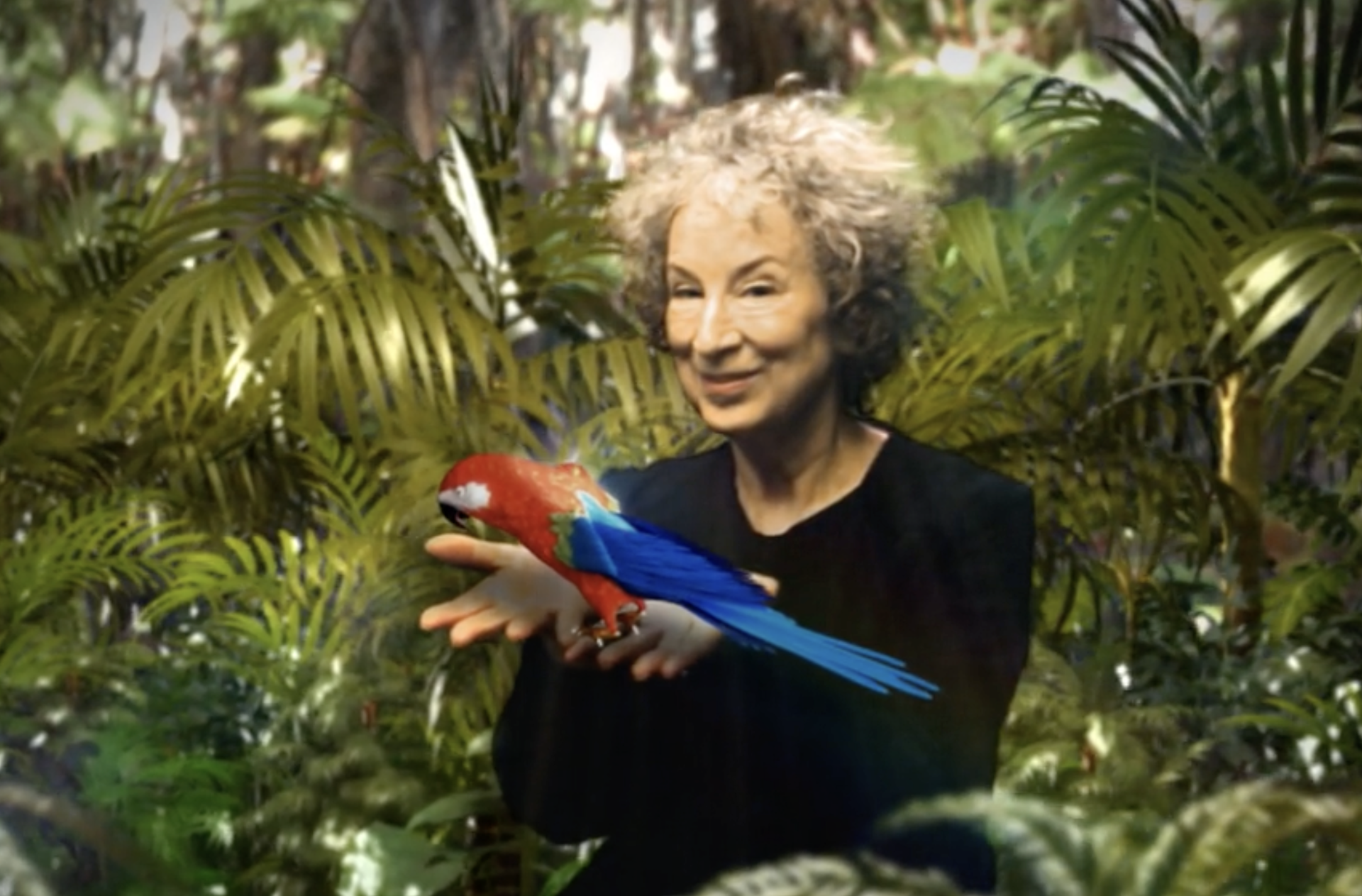
Margaret Atwood’s “Atwood Hologram” | Image courtesy of PHASE Lab
“We asked [Canadian author] Margaret Atwood to sit for a portrait,” Page shares. “Her idea was to be in a tropical forest, holding a bird, and that’s how we created what we call the Atwood Hologram. That was in 2008—a lot of the things we did then are easier to do now, but at the time it broke new ground.”
To keep PHASE Lab focused on holographic research and prototyping for scientific and educational purposes, and to attract more arts and science students interested in holography, Page designed a holography course at OCAD and taught it for 40 years. In 2008, he also started a joint course at the University of Toronto, where he still teaches today. The 13-week course pairs students to learn to make analog holograms of objects and then develop digital holograms through 3D animation software. “We try to bring the arts majors together with the physics majors,” he says. “It’s a great way to get students thinking about physics and optics. The ethos of the class is still going strong.”
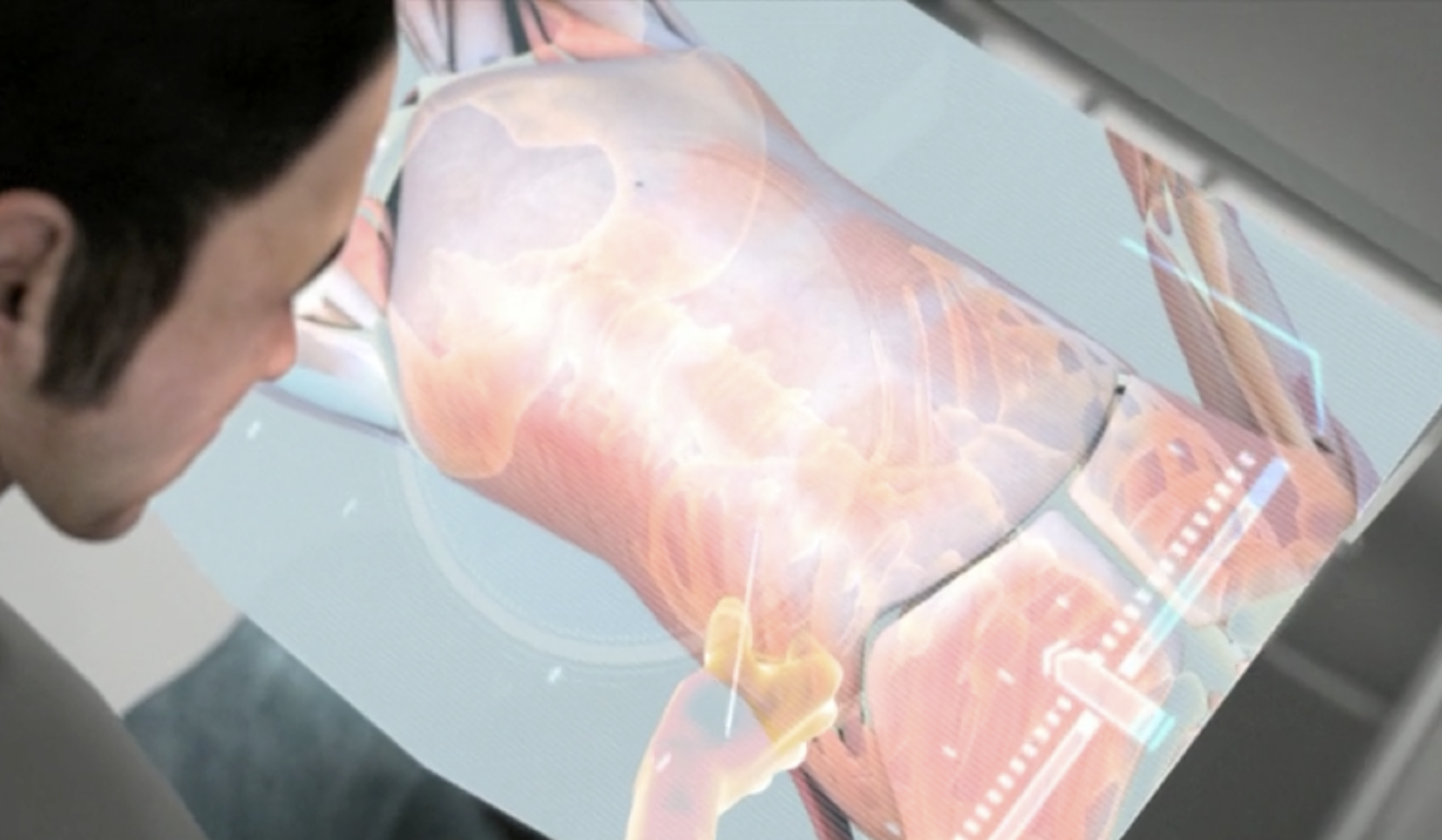
Image courtesy of PHASE Lab
In 2012, PHASE Lab partnered with Entact Robotics to focus on tactile holograms. “People always point out that in Star Trek, people can touch the hologram,” Page said. “So, we thought, let’s work with a haptic company and see what we can get.” He explained, “One criticism of digital holography is that it’s too static and not interactive.” Page and his team envisioned a hybrid workstation with autostereoscopic capabilities, with multiple layers of 3D-recorded holograms. Head tracking was used to change the perspective of the video to match that of the hologram. Finally, gesture recognition was added to the interactive menu, allowing users to “touch” the hologram and complete the experience with digitally synchronized audio. “It took a few years to fully realize this technology.” The results of that research can be found here: link.
In 2014, STM Holography and Cerebral Diagnostics partnered with PHASE Lab to develop technology to capture and display 3D views of the brain’s electrical activity during sleep. “Our research is focused on creating brain models in a commercial standard 3D format and then incorporating that into a standardized hologram print format,” Page said. “Cerebral Diagnostics wanted to be able to FTP animated video holograms to their service bureau.” PHASE ab took the dataset recorded by Dr. Mark Doidge, founder and CEO of Cerebral Diagnostics, and worked to accurately convert it into “camera-ready artwork” for the holographic printers at the PHASE Lab and STM Holography commercial service bureau. “These holograms not only represent the data in 3D, but also convey data changes in the electrical activity of the brain over time,” Page said. The research was “ahead of its time,” Page said.
PHASE Lab is also working with Toronto’s nonprofit MaRS Discovery Innovation Centre, which was established in 2000 to commercialize publicly funded medical research and other technologies with the help of local private industry. “The group we’re working with at MaRS is trying to get funding to study potential treatments for cancer, but their methods are very complex for anyone who doesn’t understand the science,” Page explained. “Our job is to create visualizations to help explain the method.” Page said the project focuses on creating “computer-controlled animated holograms for medical imaging.” “It’s a latent image, so there are 16 different 3D scenes in the hologram,” he added. “We multiplex them through RGB; because it’s computer-controlled, we can do gesture recognition and animation in it.”
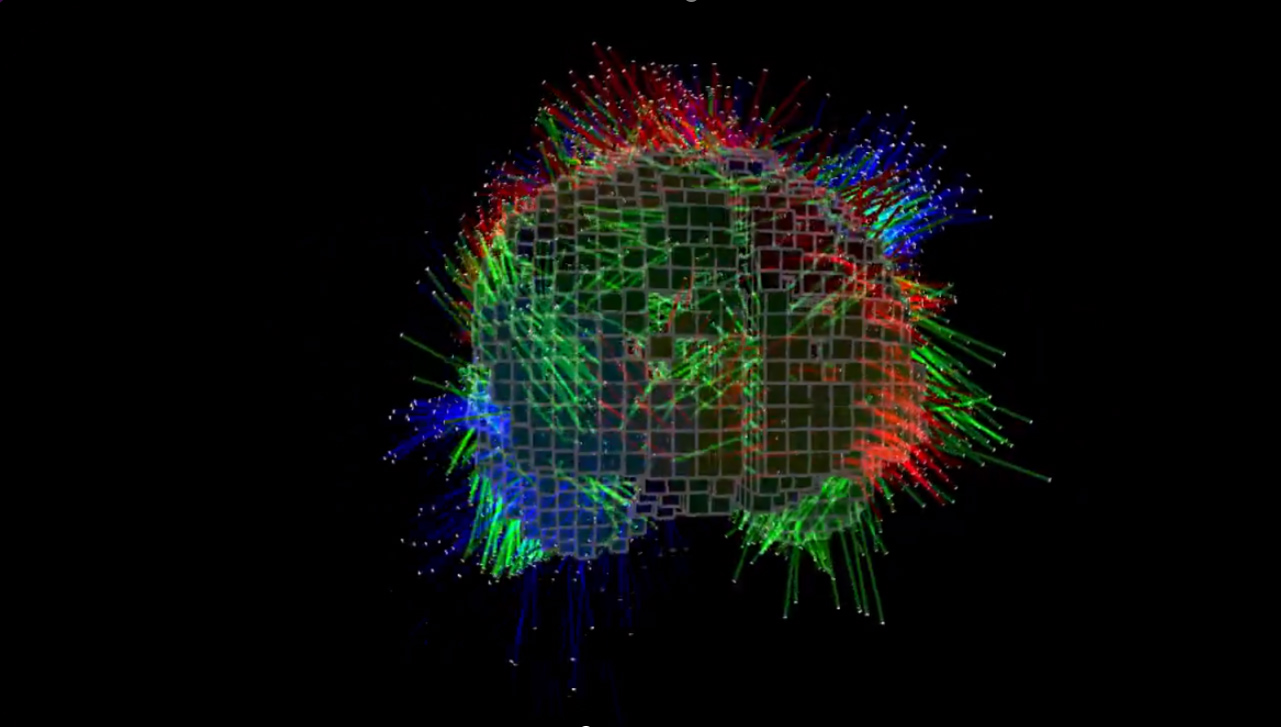
Hologram of EEG activity | Image courtesy of PHASE Labs
The lab recently received a grant to build a full-color camera that can be used to create high-quality analog holograms. Its partner, Coherent Lasers, is producing custom lasers for the project, while PHASE is applying for seed grants from humanities and science/engineering organizations to fund the development of this use case. Page is also working with museums to create accurate digital holograms of artifacts that will be repatriated. “Our decades of knowledge will allow us to build this full-color camera to do the work we intend to do,” he said. “Now all we need is industry partners.”
Page is excited about both Apple Visio Pro and Oculus Quest 3, which go beyond virtual reality in their ability to create true XR, or mixed reality. “The future of holography is hybrid,” he said. He’s also interested in MIT’s research in tensor holography, which promises to enable real-time transmission of holographic data. “These new tools are bringing us closer to mixed reality, and holograms will play a big role in that mosaic.”
Background of the PHASE Lab
- Leader: Led by Professor Michael Page.
- Location: Ontario College of Art and Design (OCAD).
- Research Expertise: Autostereoscopic 3D simulation technology, and a variety of technologies from digital holography to computational photography and haptics.
History and Development of the Lab
- 1970s: Professor Page's early interest in holography began at the Ontario Science Centre, and he established a simple holography studio in the basement of a farmhouse, and later established a second studio at OCAD.
- Federal Funding and Collaborations: In the 1990s, the Lab received some commercial work and federal funding, and collaborated with scientists at the University of Toronto and professionals in other fields to develop several innovations in the media field.
Major Collaborations and Innovations
- Light Valve Digital Holographic Printer: Developed in collaboration with Dr. Stephen Benton, to produce holograms for the arts and sciences.
- Huxley Robotic Artifact Scanner: Built in 2006, for high-quality 3D scanning of museum artifacts.
- RAIL holographic scanner: launched in 2008, in collaboration with STM Holographic, it can record 4D images and directly input into a holographic printer.
- Tactile hologram: in collaboration with Entact Robotics in 2012, it developed a hologram that can be "touched".
Education and curriculum
- Holographic courses: Holographic courses are taught at OCAD and the University of Toronto, allowing students to learn by combining art and science, including making analog holograms of objects and developing digital holograms.
- Collaborative teaching: advocating collaboration between art majors and physics majors to inspire students' physical and optical thinking.
Final stage of development
- Brain electronic activity capture and display: in collaboration with STM Holography and Cerebral Diagnostics in 2014, research on 3D view capture and display technology of brain electronic activity during sleep.
The lab's goal is to explore how brain activity is associated with dreams and other nighttime processes, ultimately creating a 3D hologram that can visualize EEG activity. "Page explained. This collaboration not only demonstrates the potential of holography in the medical field, but also reveals new possibilities for brain research.
The global pandemic in early 2020 had a significant impact on the way PHASE Lab works. Professor Page and his team quickly adapted and turned to virtual and remote collaboration tools to continue their research and education. "We developed a virtual holographic workshop that brings teachers, students, and researchers together in a virtual space for interaction." Page said. Through these technologies, the lab has been able to continue to advance its holographic research and attract more students and researchers around the world.
Overall, PHASE Lab has made significant contributions at the intersection of art and science. Their research has not only promoted the development of holographic technology, but also brought innovative applications to the education and medical industries. In the future, PHASE Lab will continue its holographic research in the fields of film, education, and medical care, and explore more possibilities for the perfect combination of science and art.
"My greatest hope is that our work will inspire the next generation of scientists and artists to continue to be bold in their imagination and innovation in their projects," Professor Page said enthusiastically.
After years of hard work and innovation, Professor Michael Page and his team at PHASE Lab have opened a new chapter in holography and will continue to lead the development of this field in the coming years.