CEDbank by Frank Chen 2024 May 19
A special signing ceremony was held at 3 pm on May 19, 2024, at the Vision Building in Toronto. Chen Zhong, CEO of Vision Holdings Group, and Simon Deng, director of ABB-FG in the United States, signed a cooperation agreement. The two parties will cooperate to locate Vision in Moatfield Dr, Toronto, Ontario 95-105# two buildings were transformed and upgraded into "GV Digital Technology Building". ABB-FG uses the most cutting-edge digital technology and professional securitization laws to integrate various real-world assets (RWA) with the support of the most reliable public chain and token platform to complete the U.S. Securities Regulatory Commission Reg.D/S/A+ Register and specify uninterrupted transactions on major well-known digital asset exchanges (ATS) around the world. After ABB-FG digitizes and securitizes 95-105#, it will be traded globally on ATS, which will greatly enhance the value of the property. At the same time, it will quickly enhance the economic growth of Foresight and realize the Internet, digitalization and intelligence of Foresight's industry. , reducing industrial costs, improving user experience and increasing industrial income will also play a huge role. Foresight will also become a pioneer in Canada's digital economy.
Visionary Group is a company listed on the Nasdaq in the United States (Nasdaq code: GV). It is the world's top 1 best strategic management implementation model for diversified and high-value innovation transformation, and will create considerable corporate high-end Profitable growth. Known for its global forward-looking development vision.
Visionary Group was born in the first digital technology building in Toronto, Canada and became the largest digital economy financial technology construction and development in North America. At the same time, it deepened its cooperation with the New York Stock Exchange ATS Digital Asset Exchange to create the world's largest digital economy asset trading leader. Promote the development of the global and Canadian digital economy, and its global and North American digital asset trading development potential and market demand are considerable. CEDbank by Frank Chen 2024 May 19


Real picture of GV Digital Technology Building
In addition, Vision plans to apply to the Toronto City Council for planning on the 95-105# vacant land, and plans to expand 3 buildings to create a digital technology complex with a total construction area of 1.5 million square feet and 5 buildings that are integrated and have complementary functions, forming a Toronto Digital economy city business card, contributing to promoting Canada’s new model of digital economic development and industrial upgrading. In the context of the fourth industrial revolution, digital technology will reshape the global economic and industrial landscape and become the strategic commanding heights for competition among major countries and enterprises. It is a key engine for global economic development. It is also a key engine for biology, energy, new materials, artificial intelligence, and A key accelerator for innovative breakthroughs in other fields. Vision Future is centered on the three major industries of biotechnology, new energy and anti-aging new products. We believe that the transformation and upgrading of Vision Future's real estate properties will have a huge impact on the development of the three major industries of Vision Future.
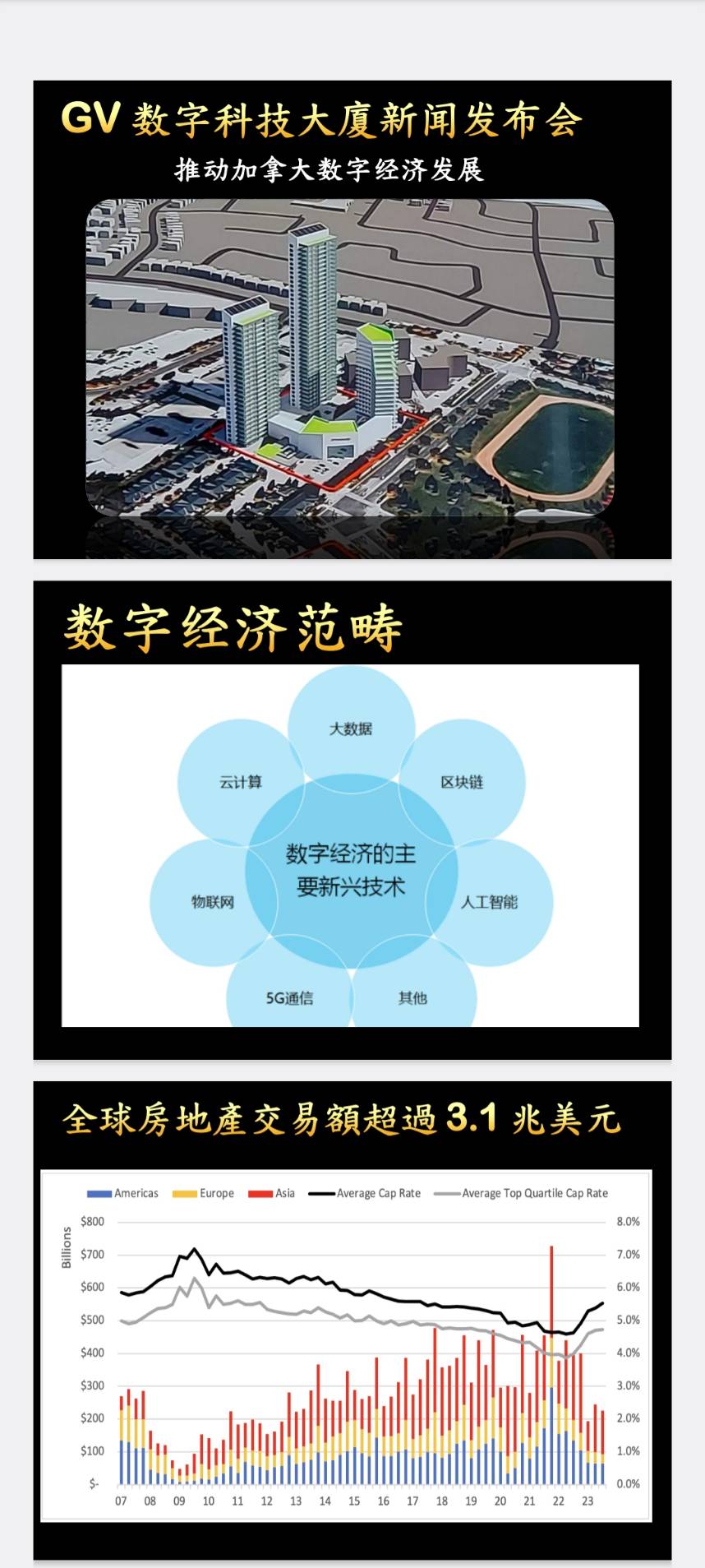
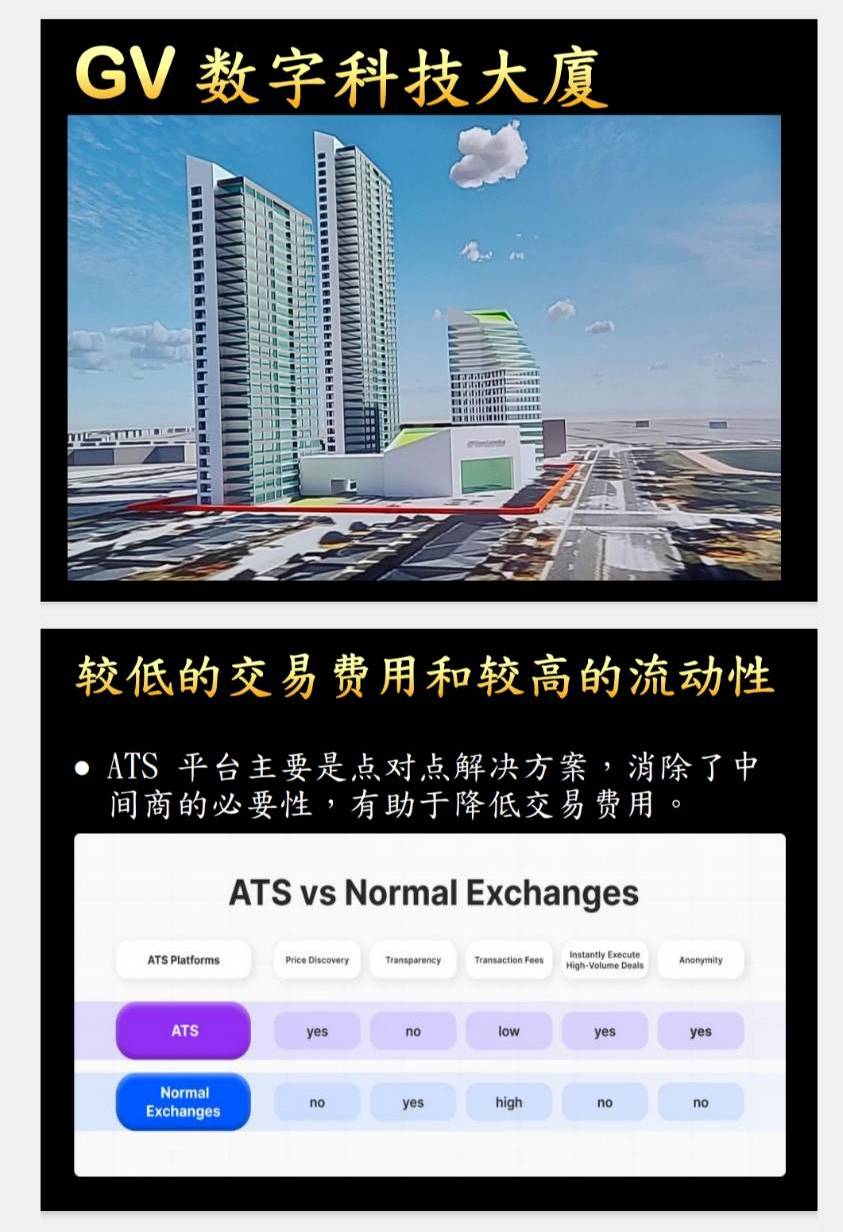
Visionary Group will conduct uninterrupted transactions with the world's leading digital asset exchanges (ATS) in Canada's largest digital economy building. The deepening integration of the world's major digital asset exchanges (ATS) is a very significant and forward-looking move. The establishment of major well-known digital asset exchanges around the world and their synergistic effects
1. Reduce transaction costs:
- The ATS (Alternative Trading System) platform uses a P2P (peer-to-peer) solution without the need for middlemen, thereby significantly reducing transaction costs. This allows investors to enjoy greater profits.
2. Improve the liquidity of real-valued assets:
- By providing higher liquidity, the ATS platform makes it easier to buy and sell assets. This improves market efficiency and makes it easier for more investors to participate in the market.
3. RWA (real world assets) merged into digital assets:
- The digitization of physical assets (real estate, business products, art, U.S. government bonds, etc.) makes it easier for these assets to be traded globally. This removes traditional geographic restrictions and enables wider market access.
4. Huge global market potential:
- The global real estate market is estimated to be approximately US$326.5 trillion, and the gold market is estimated to be approximately US$12.39 trillion. Integrating these vast asset markets into digital platforms will increase transparency and traceability, making them easier for investors to access.
5. Milestones of global digital economy:
——Canada’s largest digital economy building has settled in Toronto, representing a breakthrough in the development of digital economic infrastructure. This will become the new center of the global digital asset market, attracting more companies and capital, and accelerating digital transformation.
6. Promote global financial markets:
——This will not only promote regional economic development, but also have a positive impact on global financial markets. The emergence of digital asset exchanges will make international transactions more convenient and efficient, and promote the further integration and development of global capital markets.
7. Innovation and technological leadership:
- ATS digital asset exchange represents the deep integration of technology and finance. Leveraging advanced digital technologies, such as blockchain and smart contracts, can reduce risks, increase transparency and efficiency, and lay the foundation for future financial innovation.
The Visionary Group plan is expected to make a significant contribution not only from an economic and financial perspective, but also to play an important role in the evolution of the global economy in the digital age.

Aerial view of the future of GV Digital Technology Building
Visionary’s in-depth cooperation with major world-renowned digital asset exchanges (ATS) is indeed a globally eye-catching innovative digital financial technology, especially now that digital finance and blockchain technology are becoming increasingly mature. background. The potential profound impact of the digital economy on high-cost traditional finance:
1. Reduce transaction fees and improve liquidity:
The point-to-point solution of the New York Stock Exchange ATS (Alternative Trading System) platform can eliminate the role of middlemen, and traders can directly buy and sell digital assets, thereby significantly reducing intermediary fees. In addition, peer-to-peer trading shortens the transaction process and improves transaction speed and market liquidity. This is undoubtedly good news for investors who want to trade assets quickly.
2. Integrating Real World Assets (RWA):
Digitizing tangible assets in the physical world and trading them on digital platforms opens up a whole new market. The digitization of real-world assets such as real estate, commodities, art and even U.S. Treasuries transforms these traditionally illiquid assets into digital assets that can be quickly traded, greatly increasing the liquidity and market value of these assets.
3. Important components of global financial value:
The global real estate market is valued at US$326.5 trillion, while the market value of gold is US$12.39 trillion. These figures show that RWA occupies a huge share of the global financial market. Digitizing these tangible assets and incorporating them into the digital financial system can unlock huge market potential, create new investment opportunities, and promote the diversification and stability of the global financial market.
4. Industrial asset liquidity and the creation of value in the global digital financial system:
Judging from the scale of the above-mentioned real-world assets, digitized assets can bring significant liquidity improvements. For investors, this means that buyers or sellers of assets can be found more quickly, allowing for more efficient capital allocation. For the entire digital financial system, these newly introduced digital assets not only enhance the depth of the market, but also improve the stability and risk resistance of the market.
Vision Group's joint cooperation with the New York Stock Exchange ATS Digital Industry Exchange is not only a highly innovative enterprise group strategy, but also a major change in the structure and ecosystem of the entire global financial market. With the further development of blockchain technology and digital assets, it is foreseeable that these innovations will bring richer financial products and more global market opportunities of greater scale and scope.

1. The global development potential of the digital economy:
- Financial innovation and technical support: Canada has strong innovation infrastructure and strong technology research and development capabilities, especially in fields such as artificial intelligence, blockchain and big data. Vision Group can use these advantages to integrate resources and promote technology.
- Government support: The Canadian government actively promotes digitalization and technological innovation and has launched a series of policies and plans to promote the development of the digital economy, such as the Science and Technology Innovation Fund, Digital Economy Strategic Plan, etc.
- Generous digital economy education and talent pool: Canada has many of the world's top educational institutions, cultivating a large number of financial technology and digital talents. Canada's environmental conditions and high-quality talents are a key element for the prosperity and growth of the digital economy, and it has an absolute competitive advantage in the development of the digital economy.
2. Strong demand from the global digital economy market:
- E-commerce and digital payment: With the popularity of online shopping and the advancement of electronic payment technology, consumer demand for digital economy services continues to increase.
- Smart cities and the Internet of Things: Many places in Canada are promoting the construction of smart cities, which requires a large number of Internet of Things devices and data management services to improve city operational efficiency and residents' quality of life.
- Remote work and education: The surge in demand for remote work and online education in the wake of the COVID-19 pandemic has prompted businesses and educational institutions to invest in digital infrastructure and tools.
-Digital health: With the increase in national health awareness and the development of medical technology, the demand for digital health solutions is growing, including telemedicine, health management applications, etc.
Big data, blockchain and artificial intelligence (AI) make value contributions in the digital economy
The value of big data in the digital economy
Big data refers to technologies and methods for processing and analyzing large amounts of data.
The value that big data brings to the digital economy:
1. Provide solutions:
- Businesses can analyze large data sets to gain a deeper understanding of customer behavior and key market trends.
- Discover business patterns and trends to develop more accurate business strategies and marketing plans.
2. Management decision support:
- Increase your chances of business success by making data-driven decisions.
- Real-time data analysis enables immediate responses and preventive measures.
3. Improve operational efficiency:
- Optimize supply chain, efficiently manage inventory, improve manufacturing processes, etc.
- Collect and analyze data throughout the process to reduce waste and increase efficiency.
The value of blockchain in the digital economy (block key)
Blockchain is a decentralized and difficult-to-tamper digital ledger technology.
The value that blockchain brings to the digital economy:
1. Increase transparency and trust:
- Every transaction is recorded on a public ledger ensuring transparency.
- Improves data reliability as it is difficult to tamper with.
2. Enhance security:
- Use cryptography technology to ensure data security.
- It uses a decentralized network and is therefore highly resistant to centralized attacks.
3. Reduce transaction costs:
- Reduce costs by reducing intermediaries and increasing transaction speed.
- Use smart contracts to automatically execute contracts and improve efficiency.
The value of artificial intelligence (AI) in the digital economy
Artificial intelligence (AI) is a technology that enables machines to act as intelligently as humans.
The value of AI to the digital economy:
1. Automation and efficiency:
- Improve human resource efficiency by automating repetitive tasks.
- Increase productivity through predictive analytics and optimization algorithms.
2. Improve customer experience:
- Improve customer service through chatbots and personalized recommendation systems.
- Use speech recognition and image recognition technology to provide new forms of user interface.
3. Promote high innovation:
- Provide data insights to help develop new products and services.
- Use machine learning and deep learning to find new ways to solve complex problems.
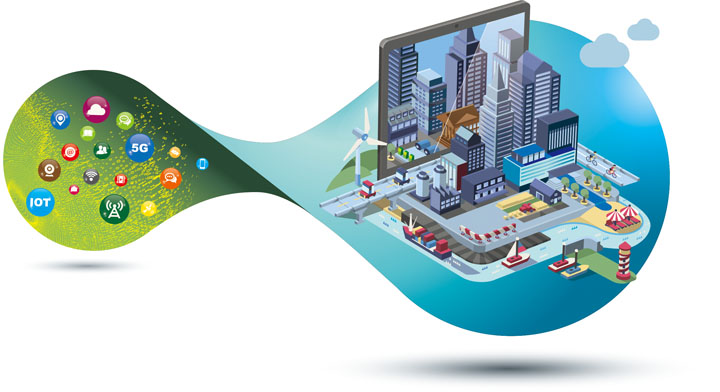
Big data, blockchain and artificial intelligence technologies work together to contribute to the development of the digital economy:
- Big data collects and analyzes large amounts of information to provide insights and support decision-making
- Blockchain** is a decentralized and non-tamperable cryptographic digital technology
Cloud computing and 5G communications play an important role in the modern digital economy:
Cloud Computing-Digital Economy Category
Cloud computing is a service that provides computing resources (servers, storage, databases, networks, software, etc.) through the Internet. Main features and benefits:
1. Scalability: Computing resources can be quickly increased or decreased as needed
2. Cost efficiency: A model in which companies don’t have to buy their own hardware and only pay for what they use
3. High availability and reliability: Use large data centers to ensure high availability and data redundancy
4. Global Access: Accessible from anywhere, making remote work and global team collaboration easy
5G communication
5G communication is the fifth generation mobile communication system, which has the characteristics of significantly improved communication speed, low latency, and high connection density. Main features and benefits:
1. High-speed communication: The data sending and receiving speed is 100 times faster than 4G.
2. Low latency: The latency required for instant communication is very low.
3. Multiple connections: Improve the ability to connect to a large number of devices at the same time.
4. Energy efficiency: low power consumption, very suitable for IoT devices, etc.
Cloud computing and 5G communications
1. Accelerate digital transformation:
- As companies adopt cloud-based services and applications, they can streamline business processes and create new business models.
- 5G's high-speed communication and low latency enable instant data collection and analysis, thereby speeding up decision-making.
2. Development of IoT (Internet of Things):
- 5G's multiple connection capabilities allow more devices to connect seamlessly.
- The use of cloud computing resources will efficiently process massive amounts of data to help realize smart cities, autonomous driving, etc.
3. Entertainment and media:
- 5G high-speed communication improves high-quality streaming and VR/AR experiences.
- Cloud-based gaming and content distribution will become more popular, allowing users to enjoy richer digital experiences.
4. Business remoteness and flexibility:
- Cloud computing facilitates the use of virtual desktops and remote collaboration tools
- 5G supports edge computing, enabling high-performance computing even at remote sites to achieve rapid on-site response.
Cloud computing and 5G communications not only promote the development of the modern digital economy, they also maximize mutual benefits. The integration of these technologies will create new business opportunities and make our lives more convenient and efficient. If you have any further questions, please feel free to ask!
Vision Group has huge potential and broad market demand in promoting Canada's digital economy. The company's technological advantages, resource allocation capabilities and market insights will lay a solid foundation for its success in Canada's digital economy.

Digital technologies are transforming economies, creating jobs and improving lives. They have dramatically transformed communications, commerce, healthcare, education, finance, and more. However, the digital divide remains stark and is becoming synonymous with the development divide. Billions of people around the world are still offline, and digital development is uneven, exacerbating the gap between the digital rich and the poor.
The digital economy has become an innovative economy that uses digital technology and electronic communications to carry out economic and business activities in a wide range of fields such as e-commerce, digital marketing, digital financial services, software development, computer games, and cloud services. The use of digital technology and electronic communications has resulted in a shift of business interactions online, resulting in improved user experience, faster processing and easier access to services and products. The digital economy is considered a major driver of economic growth and development in many developed countries and continues to expand due to its significant impact on economic and business activities. The digital economy and its impact on businesses and users, thereby increasing efficiency and productivity. The digital economy has significant impacts on a variety of economic, social and cultural sectors, including changing the way people work and interact, facilitating more flexible and remote working arrangements and increasing global connectivity. Additionally, the digital economy has impacted education, healthcare, entertainment, and other industries. Advances in technology and electronic communications have driven the global economy toward digitalization. The digital economy plays a vital role in promoting the global digitalization process, and its influence is expected to be greatly enhanced around the world in the next few years.